

The GMAT (Graduate Management Admission Test) is a standardized exam designed to assess the skills needed for success in graduate-level management and business programs, particularly MBA programs. Administered by the Graduate Management Admission Council (GMAC), the test evaluates four key areas: Analytical Writing, which measures the ability to analyze arguments and communicate ideas. Integrated Reasoning, which assesses data interpretation and problem-solving across multiple formats. Quantitative Reasoning, which focuses on mathematical problem-solving and data sufficiency; and Verbal Reasoning, which tests reading comprehension, critical reasoning, and grammar. Scored on a scale of 200 to 800, the GMAT is recognized by over 7,000 programs globally and is available year-round in computer-based formats. With a focus on assessing higher-order reasoning and analytical skills, the GMAT remains a critical tool for candidates aspiring to join top-tier business schools and advance in competitive management careers.
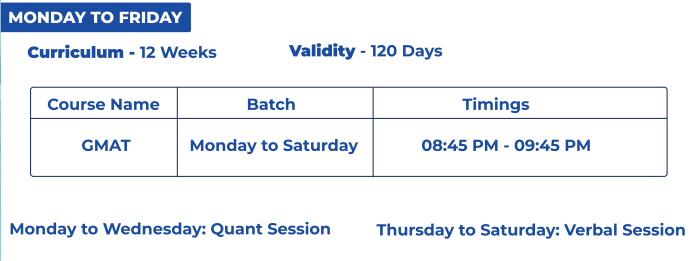
| Course Name | Batch | Timings |
|---|---|---|
| GMAT | Monday to Saturday | 08:45 PM – 09:45 PM |
| FEATURE | LIVE CLASS ONLY |
|---|---|
| Live Lectures | 60 Min |
| Live Lecture Curriculum | 8 Weeks |
| Validity | 90 Days |
| Demo Batch Access | |
| Session (Mon-Wed/Thur-Sat) | QUANT/VERBAL |
| Price | ₹ 22000/- |
Click for class timings |
A standardized test is a type of assessment uniquely characterized by its consistent administration and scoring. This uniformity ensures that all test-takers face identical questions under the same conditions, with their responses evaluated by a single, predefined grading system. The primary goal is to objectively measure specific skills or knowledge, allowing for unbiased comparison of individual performance against a common benchmark or among a large group of participants. These tests are commonly employed for purposes like academic admissions, professional licensing, and gauging educational progress.
The Graduate Management Admission Test (GMAT) is a standardized assessment specifically designed for admission to graduate business programs, including MBA, Master of Finance, Master of Accounting, and other specialized master’s programs globally. Administered by the Graduate Management Admission Council (GMAC), the GMAT measures critical higher-order reasoning skills relevant to success in a demanding business curriculum. It evaluates analytical writing, data interpretation, verbal reasoning, and quantitative reasoning abilities.
The GMAT is a computer-adaptive test that recently introduced a streamlined format, the “GMAT Focus Edition,” taking approximately 2 hours and 15 minutes (excluding optional breaks). This version maintains its focus on higher-order critical reasoning skills. It comprises three equally weighted sections: Quantitative Reasoning (1 section): Questions: 21 questions. Duration: 45 minutes. Focus: Measures problem-solving abilities, data sufficiency, and analytical reasoning within arithmetic, algebra, and geometry contexts. No calculator is permitted for this section. Adaptivity: Section-level adaptive; performance dictates the difficulty of subsequent questions within the section. Verbal Reasoning (1 section): Questions: 23 questions. Duration: 45 minutes. Focus: Assesses reading comprehension, critical reasoning, and sentence correction skills. It evaluates the ability to understand and evaluate arguments, and to correct grammatical errors. Adaptivity: Section-level adaptive; similar to Quantitative, difficulty adjusts based on performance. Data Insights (1 section): Questions: 20 questions. Duration: 45 minutes. Focus: A new section combining elements from the previous Integrated Reasoning and Data Sufficiency, it evaluates data literacy—the ability to analyze and interpret data from multiple sources and formats to solve complex business problems. Question types include Multi-Source Reasoning, Table Analysis, Graphics Interpretation, Two-Part Analysis, and Data Sufficiency.
GMAT Focus Edition scores are valid for five years from your test date.
Yes, all three sections of the GMAT Focus Edition are computer-adaptive. This means the difficulty of subsequent questions adjusts based on your performance on previous questions.
Yes, you have the flexibility to choose the order in which you take the three sections before starting the exam.
Yes, within each section, you can bookmark questions and review them. You are also allowed to change up to three answers per section before the section time runs out.
You can take the GMAT Focus Edition up to 5 times within a rolling 12-month period and a maximum of 8 times in your lifetime. You must wait at least 16 days between attempts